.png)
"Companies in the top quartile for ethnic diversity are 39% more likely to outperform their peers financially." – McKinsey & Company.
If 2025 was the year we stabilized the hybrid workforce, 2026 is the year we must optimize it.
The last twelve months have been spent learning how to be in the same room, both physically and virtually. But simply having a mix of people on a Zoom call is not enough. The data is clear: Diverse teams are smarter, but only if they are led precisely.
Additionally, as per research from Cloverpop, diverse teams make better business decisions 87% of the time. Yet, many leaders still struggle to unlock this potential because they rely on outdated management scripts.
This guide serves as your technical playbook for the upcoming year. We are moving beyond vague promises of "awareness" and into the mechanics of high-performance leading diverse teams & organizations.
Key Takeaways
- The Shift: 2025 was about stabilization; 2026 is about technical integration and behavioral flexibility.
- The Science: Use the LeaD Model to switch between relationship-building and task-execution based on team maturity.
- The Tech: AI is the next frontier for bias; leaders must audit their algorithms, not just their people.
- The Action: Implement "Equity Sprints" and structured meeting protocols to silence the loudest voices and amplify the most innovative ideas.
2025 Review vs. 2026 Outlook
Diverse, equitable, and inclusive leadership is undergoing rapid change. In 2025, many organizations will treat diversity as a PR campaign. In 2026, it must become an operational standard.
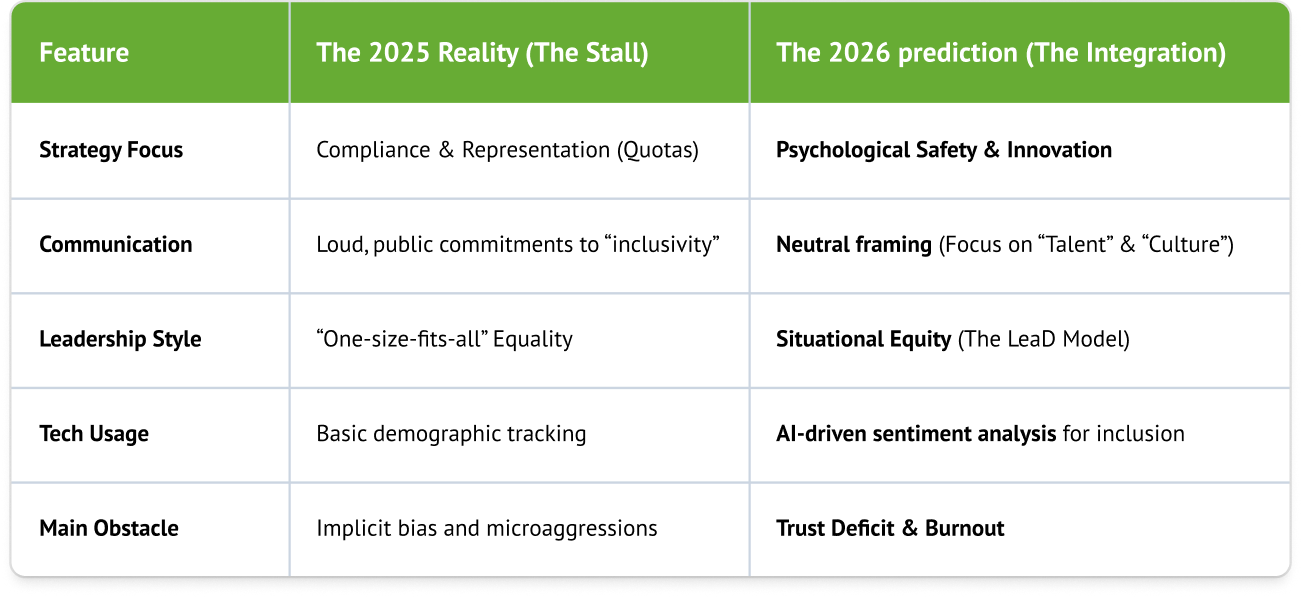
The Technical Playbook for 2026
To lead effectively in this changing environment, you need a structured approach. This is not about being "nice"; it is about behavioral engineering.
Phase 1: The "LeaD" Model (Behavioral Flexibility)
Research confirms that leading diverse teams & organizations requires "behavioral flexibility." You cannot use the same style for every phase of a team's life.
- Scenario A: The Fractured Team. Your team is diverse but cliquish.
- Action: Use person-focused leadership. Stop talking about KPIs. Schedule "culture-sharing" sessions. Use 1-to-1s to mediate conflicts.
- Scenario B: The Cohesive Team. Everyone gets along, but innovation is flat.
- Action: Pivot to Task-Focused Leadership. Now that trust exists, push for "respectful conflict." Assign "Devil's Advocates" in meetings to challenge the consensus.
Phase 2: The Neuro-Inclusion Upgrade
In 2026, diversity will include the brain. With diagnosis rates rising, your team likely includes people with ADHD, autism, or dyslexia. Leading an inclusive team means adjusting for this.
- The "User Manual" Method: Have every employee write a "User Manual" for themselves.
- Prompt: "I do my best work when..." (e.g., "I have noise-canceling headphones," or "I receive instructions in writing, not verbally").
- Avoid "quick chats" with the team without an agenda. The productivity of neurodivergent employees can be destroyed by unplanned interruptions. Provide an agenda 24 hours in advance.
Phase 3: Crushing "Proximity Bias" in Hybrid Work
Proximity bias—the tendency to favor people we see physically—is a major threat to equity. Data shows that women and caregivers are more likely to work remotely. If you only promote those you see in the office, you limit your talent pool.
The Hybrid Equity Protocol:
- The "One Remote, All Remote" Rule: If one person joins a meeting via video, everyone joins via video, even if they are in the same building. This levels the playing field.
- Digital First Feedback: Do not give career-changing feedback in the hallway. Document it. If it’s not written down, it won't happen.
The New Barriers: Hybrid & AI
1. Crushing Proximity Bias
In a hybrid world, the people sitting next to the boss get promotions. This is "Proximity Bias," and it disproportionately affects women and caregivers who frequently work remotely.
- The Fix: Adopt a "One Remote, All Remote" policy for meetings. If one person is on Zoom, everyone joins via their own laptop, even if they are in the office. This equalizes the visual playing field.
2. Algorithmic Inclusion
AI is now a team member. But AI models can be trained on biased data, replicating past prejudices.
- The Fix: Leaders must audit AI tools used for hiring or performance tracking. Ensure your "digital managers" aren't filtering out non-traditional resumes or flagging diverse communication styles as "low engagement."
The Manager’s Script: What to Say
Knowing theory is good, and what to say is better. Use these scripts to navigate implicit bias and microaggressions without causing a scene.
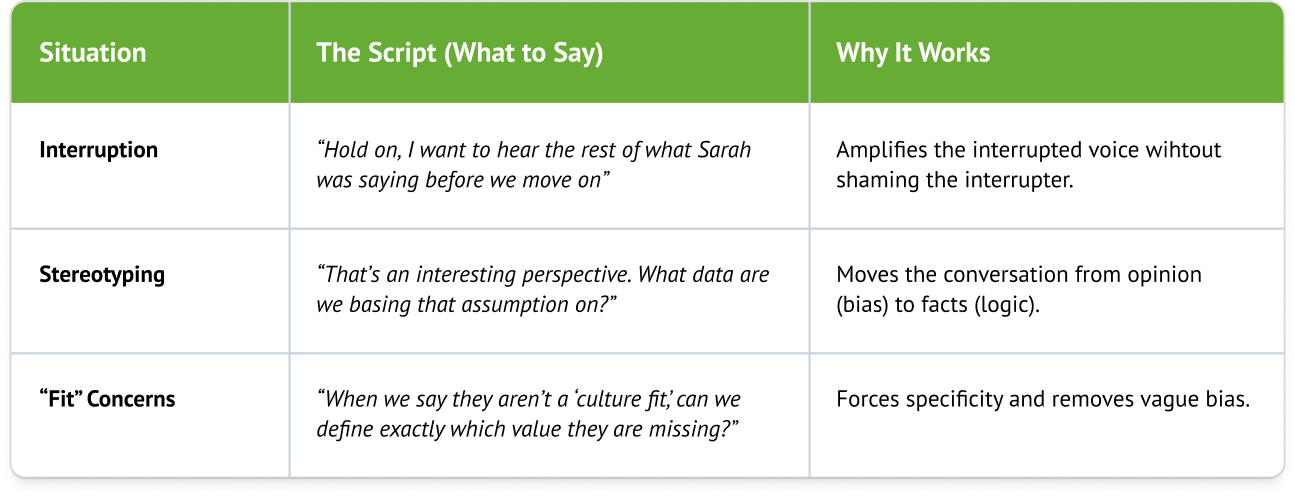
3 Critical Stats for the 2026 Leader
You cannot manage what you do not measure. These three statistics highlight the urgency of adapting your leadership style.
- The Ambition Gap:
For the first time, women are becoming less interested in promotions than men due to the "broken rung" at the manager level. - The Trust Recession:
Only 29% of employees trust their direct manager. Without trust, diversity initiatives fail because employees won't share unique ideas. - The Innovation Penalty:
Companies with below-average diversity scores are 29% less likely to achieve above-average profitability.
Conclusion: The Year of Precision
The time for generalizations is over. Leading diverse teams & organizations in 2026 requires the precision of a surgeon. It requires diagnosing the specific type of bias (proximity, affinity, or algorithmic) and applying the specific technical fix.
This is not just about being "good" people. It is about building resilient, profitable, and dynamic organizations that can survive the volatility of the future—supported by Inclusive workplace training that embeds equity, trust, and accountability into daily operations.
Don't guess. Train.
Your managers are your frontline. Give them the technical skills to lead. Master the Art of Leadership with CT3 Training